A Discussion Of My Short Story Hooked

The inspiring image for this story was quite different than the final product. Just a sketch of this strange cave encrusted with lichen and moss, and the terrible rumblings from the depths. I had no back story or characters to explore the cave. I could never figure out the rest of the story, so I shelved it, and moved along to work on something else.

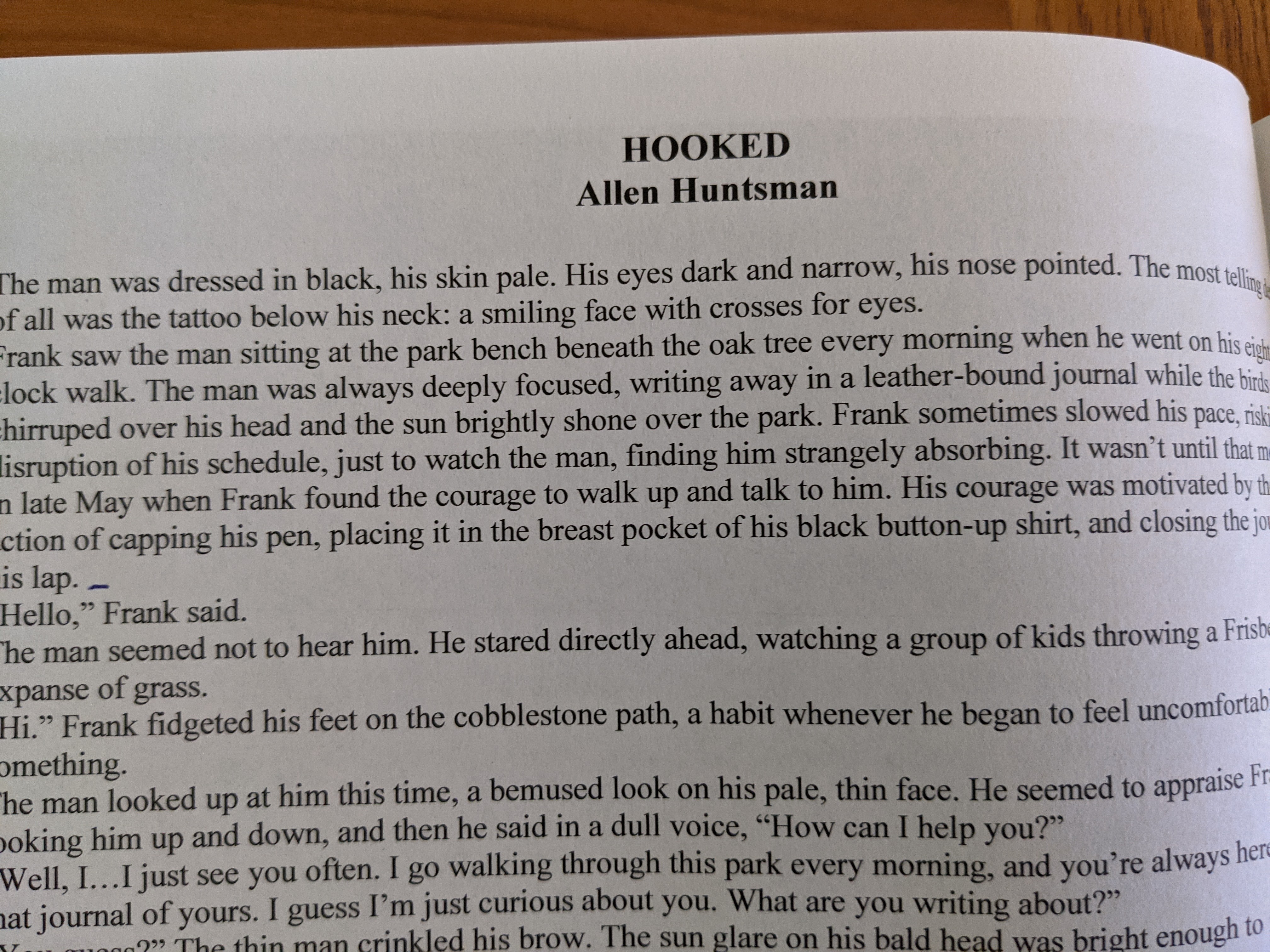
Months later I wrote 500 words of a new tale, this one about a school teacher named Frank who enjoys his summer vacations doing yard work and walking around the neighborhood park. Soon reading becomes his new pastime when he meets a mysterious tattooed man sitting at a park bench writing in a notebook. This new acquaintance is horror author Charlie Royal. Frank strikes up a conversation with the man and learns about what he’s writing. Frank has never been a horror fan. He just can’t understand why anyone would want to dream about horrors with so many real horrors going on in real life. Yet, he’s curious. He wants to understand the attraction. He steels himself by reading stories from classic authors in the genre, preparing to read Mr. Royal’s work in progress with the hope of helping him critique it. Matters turn very dark when Frank begins reading Charlie’s tale. The ink in those diary pages conjures something menacing, and Frank becomes possessed by it. The sketch of the cave I had made months prior turned out to be the lair for the monster that possesses Frank.

I wrestled with conflicting matters while writing this story. I love horror stories, and part of me wanted to express that love for them, to celebrate them. However, there were many other conflicting voices in my head at the time, particularly of those that expressed Frank’s opinion: “Why would you want to dream of horror when so many real horror takes place in real life?” I was raised in The Church of Jesus Christ of Latter-Day Saints and still practice the religion today. I’m someone who has grown up around the opinion that stories about demonic possession, rampaging zombies, serial killers, and the many unnameable terrors out there can invite evil influences into your life. Part of me even agrees with this sentiment to some degree, although I see the line differently than many in my community, and a discussion on the matter should be consigned to an entirely different post. Let’s just say I’m fine if evil is depicted in fiction, so long as the author isn’t attempting to promote or enact the evil.

I love the horror story, but I guess there’s a part of me that still feels a little guilty about it, because those voices from my upbringing continually echo in my head. “Hooked” was an attempt to puzzle out the quandary as well as an opportunity to explore the opposite point-of-view through the eyes of my main character. I see some maturity in this story. The characters are far more fleshed out than my previous stories. They exhibit more depth and complexity, the story’s greater length allowing for this.

A small amount guilt for my love of horror still exists to this day, and maybe that’s healthy. It’ll hold me back from becoming too gratuitous with a violent scene and prick at me if I do cross the line into the territory of promoting evil instead of merely depicting it. I sure hope I never create the monstrosity Charlie Royal does with his writing, or readers of my work will be disappearing into a dreadful place.

You can find my story here.

Lessons Learned While Writing A Short Horror Story

I published “Lights Out” back in the Spring of 2010, but I wrote the rough draft back in 2007. This story went through many incarnations. Most of them were completely ridiculous. Let me tell you why.

Beta readers can be a wonderful asset. Sometimes writers can get too close to their work, falling so deeply in love with their own writing that they miss major plot holes or wonky characterizations. Or the complete opposite occurs and the writer thinks their story is a total drag, an embarrassing mess that should be deleted to the void and forgotten about forever. The beta reader can help us writers in a few ways.

1) They can bring us to the realization that our literary darlings aren’t as dazzling as we think they are, bringing us back down to earth from our ethereal writing heaven.

2) They can emphasize what is working when we falsely think every word is dead on the page.

3) They can drive us crazy, sending us in a vicious cycle of endless revisions and editing.

Number three is what happened to me. At the time I was writing “Lights Out”, I was also taking my first creative writing class. The idea for the story had been on my mind for some time and I decided I could use it for the class and find ways to really improve the story from class instruction. Early on, the instructor for the class, a stocky bald man who went by Dr. Armstrong, emphasized the importance of dramatization, especially when writing a short story of eight pages. In the first draft I summarized too much. You know the old saying every writer gets pounded on the head with now and then: “show don’t tell.” I was telling too much. “Too much exegesis. Dramatize. Cinematic rendering.” I think these were some of the comments my instructor wrote on the first draft.

When it came to my fellow classmates’ comments, they had a far different issue with my story. Their issue had something to do with my use of enigma. “Lights Out” is a story about a detective investigating a scene where a young boy’s parents have mysteriously died. Blood seeps out their ears, darkness has engulfed their eyes. The boy feels certain he is the cause of their death, and Detective Palmer believes this troubled guilty reaction is just the trauma talking. He plans to take the boy to his grandma’s after further investigation at the police station. Matters turn very bad on the drive to town. A deer runs out in the road, causing the detective to wreck the car into a tree. Stranded and waiting for backup, the boy unveils to Detective Palmer that he has a strange light inside him, a power, an entity, that when awakened can cause devastating effects. This power is demonstrated, and when other detectives arrive on the crash scene, Detective Palmer is dead (exhibiting the same death signs as the boy’s parents), and the little boy is gone, until they get a clue of his whereabouts, a mad cackling in the woods.

Fellow classmates liked the story. They were fascinated by the concept and the eerie atmosphere of it, but the enigmatic ending bothered them. Many of my classmates deluged me with numerous ideas of how the story should end; they wanted it wrapped up in a pretty bow. Others suggested the eight pages written were the prologue to a novel (this I have considered, though I haven’t seen the rest of the story yet). I took every one of their comments seriously. I wanted to please every one of them. Let the maddening vicious cycle begin. I ended up rewriting the story nearly a dozen times, trying to correct what everyone saw wrong with the ending. My various incarnations of the story grew so out of hand that they no longer resembled the original draft.

One day Dr. Armstrong flat out told me just to ignore them. I was hesitant to do this. Wasn’t that rude? Didn’t they have something helpful to add to my story? My instructor insisted, “Ignore them.” I did.

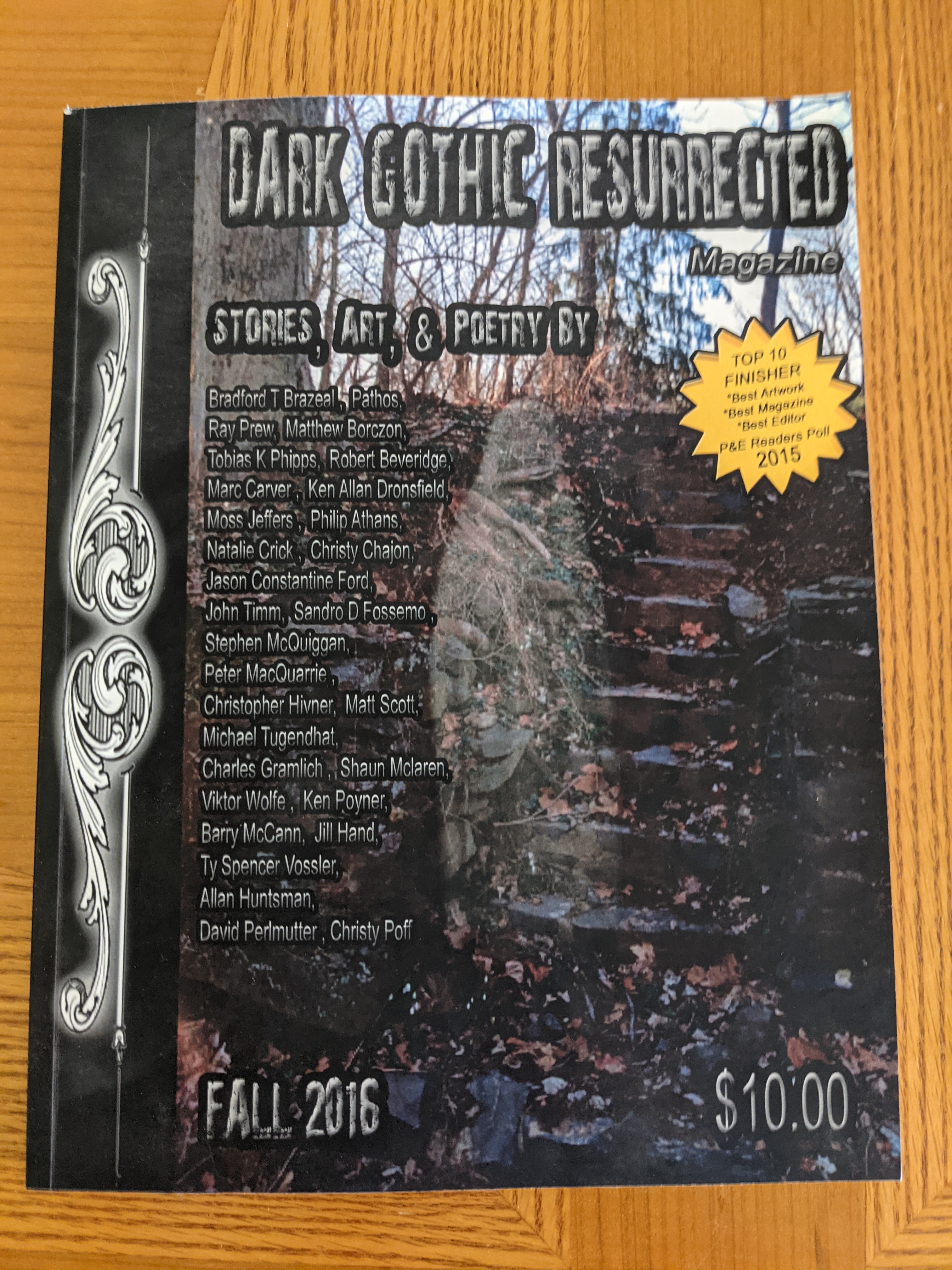
A couple years later I returned to the original draft of this story, polished it up again, and submitted it to Dark Gothic Resurrected. The chief editor, Cinsearae S. appreciated it, replying in the acceptance letter that it was “creepy as hell.” I was glad it found a home. All these years later it has found a new home, a reprinting in Dark Dossier.

I learned a couple lessons from writing this story. Even though beta readers are invaluable for the purpose of helping you see your story in new ways, at the end of the day you’re not going to please them all. You’re the boss of your story when it comes down to the bottom line. Also, not every suggestion they make is correct. I think the enigmatic ending of my dark tale works better than a more unambiguous ending. The enigma sends that thrilling shiver up your spine and stimulates conversation amongst readers, allowing them the pleasure to puzzle over together what happened in the ending.

If you’d like the pleasure to puzzle over this dark mystery of my imagination, you can find my story in two locations below:

Dark Gothic Resurrected

Dark Dossier

The Writing Process and my Latest Work The Butterfly Girl

Story ideas can knock around in a writer’s head for a long time. Inception can happen in a variety of ways: an image of a particular character, an inspiring passage, a plot element, theme (though many authors emphasize never to start with theme), what have you. Nearly fourteen years ago inception happened to me in the form of a title and a memory: The Butterfly Girl.

I knew a girl in high school with that nickname. I can’t remember precisely, but it seemed she liked to sport butterfly hair clips, so classmates gave her the alias. As I reflected on the memory of that girl, I found myself repeatedly saying to myself her nickname. It had a catchy quality to it. I thought it might serve as a great title. There was a mysterious quality to it, suggesting all kinds of connotations. Since my imagination often wanders into the strange shadows of the horror tale, I began to imagine a transformation story, one with monstrous possibilities.

Writers will often use metaphor in the attempt to understand what they do. Thomas Williams described the writing process in his novel “The Hair of Harold Roux” akin to characters standing around a small fire, their faces barely visible in the dim light. The author’s job is to keep the fire ablaze, keep the sparks flying, or the characters will be swallowed up in the dark and forgotten. Stephen King has described the writing process as like excavating a fossil. An idea, character, or phrase is the location of a fossil. Writing the story is the work of digging up the bones. Revision then must be cleaning off the bones and connecting them in their proper formation. I’ve heard others describe the writing process as like planting a seed in the ground and giving it a place to grow. The rough draft is the hedge bush grown to its most rampant potential, shaggy and shapeless. Revision is seeing the true shape that could exist, and making the proper cuts to bring that shape to life. With my story, the title was the first spark of story-creation fire. The title was the first protruding hint of a fossil to be dug up. It was the germinating seed.

Since then “The Butterfly Girl” has now become a full-length story. Right now I’m in the process of cleaning off the fossil and realizing how it all fits together.

How do you envision the writing process?

“Stories are found things, like fossils in the ground… Stories are relics, part of an undiscovered, pre-existing world.”

Stephen King